 The Hard Problem日本語
The Temptation of
Mind–Body Dualism
Nobuhara Seminar “Philosophy of Mind and Philosophy of AI”
Session 1 Summary
This English version is a translation of an AI-generated summary of the lecture. The original summary (in Japanese) was produced by AI from a transcript of the Zoom recording, and the wording of remarks has been edited in summarizing them.
Overview
The memorable first session was titled “The Temptation of Mind–Body Dualism.” It introduced the fundamental question of the philosophy of mind, the mind–body problem—how does the mind relate to matter, and above all to the brain?—and laid out the three logically possible positions on it (mind–body dualism, mental monism, and physical monism). Moving back and forth between Descartes and contemporary philosophy, it then examined why mind–body dualism, so deeply rooted in our common sense, is so attractive, and where it breaks down.
Professor Nobuhara’s own position is physical monism (physicalism). That is precisely why he describes being “drawn” to dualism as being “tempted.” Participants’ questions were taken throughout the lecture, and from the very first session there were serious philosophical exchanges on the relation between idealism and science, the meaning of the concept of substance, emergence and reduction, and more.
Lecture
The seminar’s ethos: arguing in the spirit of yuiga dokuson
Before the lecture proper, the professor described the attitude he hopes participants will bring to the seminar. Its slogan, he said, is yuiga dokuson—a Buddhist phrase, “I alone am honored,” taken here in the (non-original) sense that one regards oneself alone as worthy: “If someone can do something you can’t, just think ‘So they can do such a trivial thing?’ and stand your ground.” He also told the anecdote that every professional Go player believes they are the strongest, so if you want to know how players rate one another, you have to ask, “Who is the second strongest?” Philosophy is not about listening reverently to eminent people. If something seems wrong or makes no sense to you, then the argument is what is at fault, so say so without hesitation.
The mind–body problem: the fundamental problem of the philosophy of mind

Philosophical questions take the form “What is X?” The fundamental question of the philosophy of mind is “What is the mind?” The mind consists of countless mental states—perception, thought, emotion, volition, and so on—and of mental processes, which are their unfolding over time. The most important angle from which to approach this question is the mind–body problem: how does the mind relate to matter, in particular to the body, and above all to the brain?
How we answer this question also settles our answers to problems humanity has long pondered, such as “Does the mind survive the death of the body?” and “Can a computer have a mind?” The latter was raised as early as 1950 by Turing, himself a designer and builder of computers.
There are three logically possible positions on the mind–body problem: (1) mind–body dualism (mind and matter are different), (2) mental monism (everything is mind: mentalism or idealism), and (3) physical monism (everything is matter: materialism or physicalism). Because in Japan the word “materialism” tends to call to mind Marxist dialectical materialism, the lecture uses the terms “physicalism” and “physical monism.” The ancestor of present-day Anglo-American physicalism is rather the mechanistic materialism of the eighteenth-century French Enlightenment (La Mettrie’s Man a Machine), which dialectical materialism criticized as “vulgar.”
Q&A: How do idealists view science?
At this point a participant who does research in neuroscience asked how people who hold an idealist position view science, which led to a long exchange. The professor explained it using the example of the “monism of appearings” (tachiaraware ichigenron, a form of phenomenalism) of Shōzō Ōmori, under whom he studied as a student. All that exists are appearances to consciousness (“appearings”); to say “the banana is there even when I close my eyes” is nothing other than the regularity and order of appearings—that whenever I open my eyes, I see the banana.
Q. How does idealism deal with unconscious information processing, or with brain activity that never reaches consciousness?
A. It does not acknowledge them at all. Only what appears to consciousness exists. “The unconscious” exists only insofar as it can be interpreted as corresponding to regularities and order among appearances to consciousness.
Q. Then what is “prediction” for idealism?
A. Prediction is, if anything, idealism’s home ground. To predict is to predict what will be observed next from what is observed now—in other words, it is nothing but a relation among appearings. The mathematical equations of science can also be used as tools for expressing the order of appearings. This is exactly the debate in the philosophy of science between scientific realism and anti-realism, and “philosophically, anti-realism generally turns out to be the stronger side.”
To a follow-up question about whether there could be an idealism that avoids solipsism, he answered frankly: “Unless you bring in something like the mind of God, I think solipsism is an almost inevitable consequence of idealism.” Ōmori, he added, also held a thoroughly solipsistic position.
Substance dualism: Cartesian dualism and folk dualism
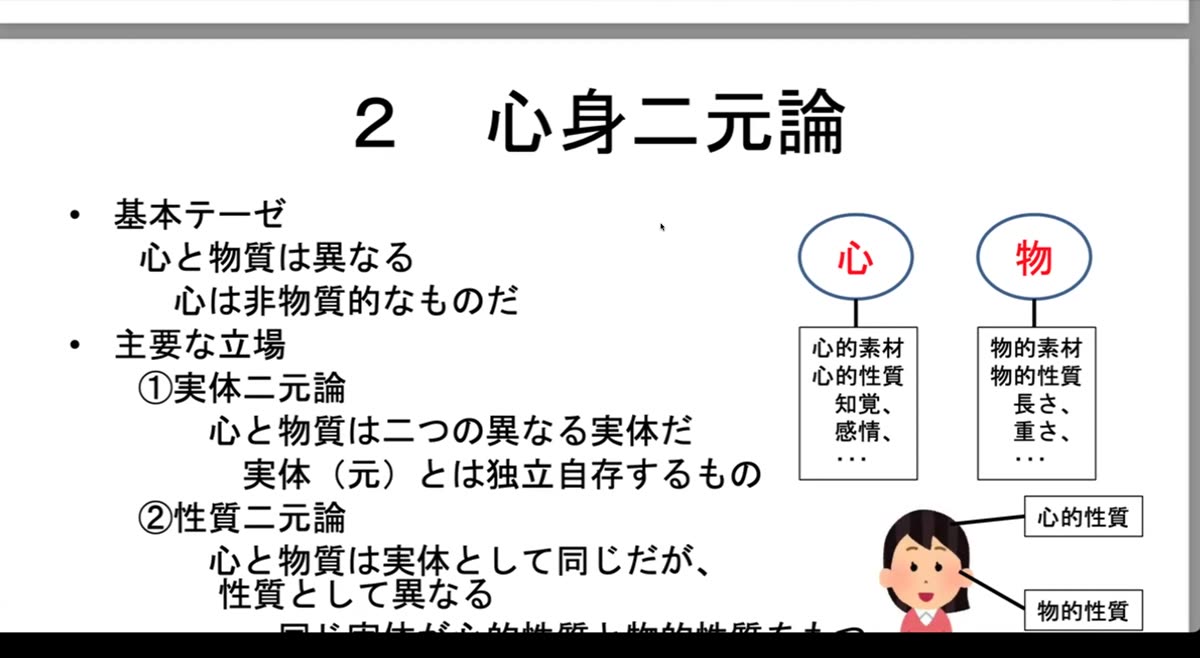
There are two main forms of mind–body dualism: substance dualism and property dualism. A substance is the underlying bearer of properties, and philosophically it is defined as “that which exists independently, in and of itself”—something that is not affected by anything else and initiates change from within itself. Once this definition is adopted, if mind and matter are different substances, then interaction between mind and body is impossible.
Here an important distinction is introduced: Cartesian dualism as a philosophical theory, and the folk dualism that our common sense vaguely assumes. The latter is the “ghost in the machine” view that the mind is distinct from the body yet dwells in it, interacts causally with it, and can survive the body’s death. But if substance is defined as existing independently, interaction cannot be admitted, so this view collapses when pursued philosophically. “When common sense is pursued philosophically, contradictions or inconsistencies always emerge, and it breaks down.”
Descartes’s dualism: a metaphysics for mechanistic natural science
Descartes located the essence of matter in extension (spatial magnitude) and the essence of mind in thought (cogitatio, cognition in general in today’s terms). Mind and matter share only time; in spatiality they are decisively different substances. Interaction between mind and body is therefore impossible by definition, and the fact that mental and physical events occur together has to be “pure coincidence.” Because the intellect cannot rest content with such “coincidence,” there arose occasionalism, according to which God arranges the correspondence, and Leibniz’s doctrine of pre-established harmony.
Three reasons are given for why Descartes adopted dualism. (1) Through introspection, it is indubitable that I am a thinking substance (I think, therefore I am). (2) It is inconceivable that a purely material system could have linguistic or mathematical abilities, and at the time what was inconceivable was held to be metaphysically impossible as well (this inference itself has become a major issue in contemporary philosophy). (3) And the biggest motive: by shutting the influence of mind out of the material world, the causal closure of the physical—the principle that every cause of a physical event is a physical event—is secured, setting the stage for a purely mechanistic natural science that encompasses even the phenomena of life. The great development of modern science followed from this setup.
Descartes himself, however, was troubled by the commonsense appearance of mind–body interaction, and offered the strained solution that a subtle matter called “animal spirits” mediates between mind and body in the brain’s pineal gland. “It’s the feeling that if you make something subtle enough you can give it magical powers—that if you think of something ghost-like as a subtle kind of matter, it starts to seem as if it could act on the body,” the professor remarked.
Property dualism: epiphenomenalism, interactionism, and fundamental property dualism
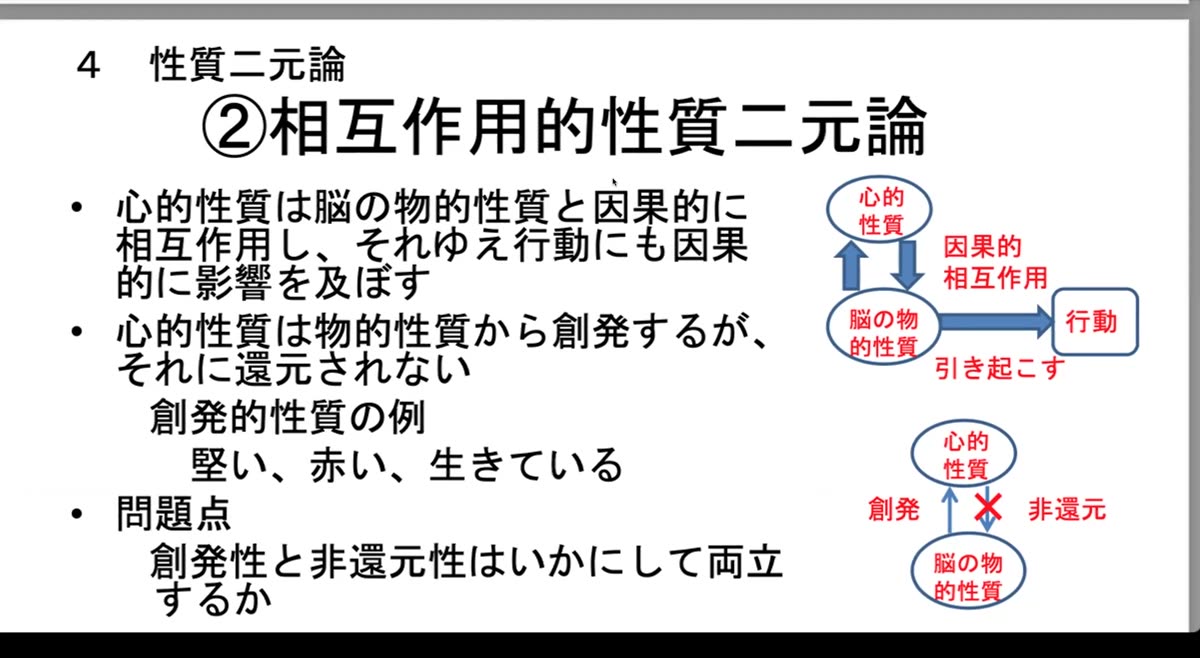
Property dualism holds that one and the same substance has two different kinds of properties, physical and mental. Spinoza held that God, the sole substance, has two properties (attributes), but for us today the starting point is rather the thought that “human beings, who have minds, are themselves property-dualist beings.” Three forms were introduced.
- Epiphenomenalism: physical phenomena give rise to mental phenomena, but mental phenomena are causally powerless with respect to physical ones. What produces behavior is always the physical process in the brain; the mind merely arises alongside it. The problem: when I will to raise my hand and my hand goes up, I cannot help thinking that my will caused the action.
- Interactionist property dualism: mental and physical properties interact causally. In particular, the emergentist view holds that mental properties emerge from physical properties but are not reduced to them. The model is properties such as the hardness of a diamond or the redness of a tomato, which arise from the arrangement of their constituents yet are not reducible to it. The problem: how emergence and irreducibility can be compatible is a hard philosophical problem that “never seems to get settled.”
- Fundamental property dualism: mental properties are not emergent but exist fundamentally, alongside physical properties. The problem: if we consider evolution, life—and then mind—came into being from a world of matter alone, so mental properties still look emergent.
Here a participant asked the incisive question of what the “dual” in this kind of dualism means. Whereas the “dual” in substance dualism is defined by independent existence, the “dual” in property dualism is defined by whether reduction is possible. An important clarification was made: even under the same label “dualism,” what counts as one of the two depends on the theorist, and this needs to be kept in mind.
Four arguments for dualism and their problems
Four arguments were examined as reasons why we are “tempted” by dualism.
- The argument from religion: many religions teach the immortality of the soul. → There are many cases in which religion has hindered the resolution of scientific questions, such as the suppression of heliocentrism and the denial of evolution, so religious doctrine is not reliable.
- The argument from introspection: what introspection reveals is not electrochemical phenomena in the brain but mental phenomena. → Is introspection really infallible? As in the case where water at room temperature feels warm after you have put your hand in cold water, introspection may also err—a challenge raised in analytic philosophy since the mid-twentieth century.
- The argument from irreducibility: computational ability, linguistic ability, and above all qualia (the sensory qualities that appear in consciousness) and mental content (the content represented by intentionality, the mind’s capacity to represent something) cannot be reduced to anything physical. → Arguably, calculators already have computational ability and large language models (LLMs) linguistic ability. What remains, qualia and intentionality, are the “main challenges” to physical monism; the reduction of intentionality will be taken up in detail in Sessions 3–4, and the reduction of qualia and consciousness in Sessions 5–6.
- The argument from parapsychological phenomena: telepathy and psychokinesis cannot be explained by physics. → To begin with, reliable parapsychological phenomena seem unlikely to exist, and even if they did, they might be physically explicable in light of technologies such as BBC (brain-to-brain communication).
Four arguments against dualism

- Simplicity: given equal explanatory power, the fewer fundamental entities the better (Occam’s razor). Dualism posits two; monism, one.
- Explanatory power: neuroscience has elucidated many psychological phenomena, as with the discovery of the dorsal and ventral visual streams. Dualism has offered nothing that could be called a “theory” of the mental stuff it posits.
- The neural dependence of mental phenomena: sensation, reason, emotion, and consciousness all depend on neural activity. For substance dualism this dependence can only be a “coincidental correlation,” which is hard to make sense of.
- Evolutionary history: living things are products of ever more complex organizations of matter, and it is hard to believe that, either in evolution or in individual development, some supernatural event occurred in which the “breath of mind” was blown in. Once the organization of matter passes a certain stage it has life, and once it passes a still higher stage it has a mind—isn’t that all there is to it?
From the Discussion
After the lecture, questions continued past 10:30 p.m., and the session ended shortly before 11:00 p.m. The main exchanges are summarized below.
- The course of the history of philosophy: in answer to a participant’s question, a broad overview was given. Starting from Descartes’s dualism and passing through Spinoza’s mind–body parallelism and Leibniz’s pre-established harmony, the mainstream of modern Western philosophy turned instead toward idealism (the German idealism of Kant, Hegel, and others). From the late nineteenth into the twentieth century, it then swung toward materialism, along with Marx’s turn, the birth of psychology, and the spread of the theory of evolution.
- Can reincarnation be interpreted within physical monism?: historically, reincarnation has always been put forward within a mind–body dualist framework. But a position that interprets reincarnation under physicalism “should be logically possible. If you are interested, please do work one out and propose it.”
- Shifting common sense: it was once naturally accepted that “the soul survives even when the body perishes,” but today the sense that “when you die, your mind is gone too” is growing stronger. One participant said candidly that they had thought the mind disappears completely at death and that funerals were mere ritual. The professor replied: “Then why do you think so? If that is right, are we being made to do meaningless things at funerals and memorial services on the forty-ninth day? Please take that as a starting point for thinking.”
- Invisible light and idealism: other animals may perceive ultraviolet light, which never appears in human consciousness. Even so, the idealist replies that “the very grounds for saying animals have other senses are obtained from appearances to my consciousness.” The distinction between “things that can in principle appear to consciousness, like a banana” and “things that can never appear, like an electron,” however, remains an important issue.
- Instrumentalism as a strategy: if positing matter explains mental phenomena better, the idealist may use matter as a “tool.” This is precisely the strategy of scientific anti-realism, and it has the same structure as when Copernicus, before theologians, presented heliocentrism as a convenient device for easily predicting the motions of the heavenly bodies.
- In philosophy, reaching a stalemate is a good result: there is no final resolution to the debate between materialism and idealism. “If you can bring a philosophical argument to a stalemate, you’ve done well. The rest is a matter of how you live. Those who take idealism live as idealists. You should not hold materialism while living as an idealist—please make your position and your way of life consistent.” Citing the controversy in the mathematical community over the proof of the abc conjecture, he also remarked that “even mathematical proof has become a philosophical problem.”
Summary
Session 1 sketched the overall map of the philosophy of mind from a single point: the mind–body problem. Mind–body dualism is an attractive position deeply rooted in common sense, but if substance is defined as independent existence it cannot explain mind–body interaction, and retreating to property dualism only leads to the dilemma of emergence and reduction. Idealism, on the other hand, is philosophically robust but pays the price of solipsism. Physical monism appears to be the remaining path—but to take it, one must overcome its two greatest obstacles, qualia and intentionality, by carrying out the physical reduction of both.
“Whether reduction is possible—that is exactly what the debate is about.” In the coming sessions this question will be developed in earnest: functionalism (Session 2), the reduction of intentionality (Sessions 3–4), and the reduction of qualia and consciousness (Sessions 5–6).
Presentation seminars are scheduled to be held on the second Wednesday of every month from March 2027.
This report was produced by AI from a transcript of the Zoom recording and reviewed by the secretariat of the Consciousness Research Foundation. The wording of remarks has been edited in summarizing them. This English version is a translation of that AI-generated summary.
← Back to The Hard Problem of Consciousness Project (Nobuhara Seminar)